

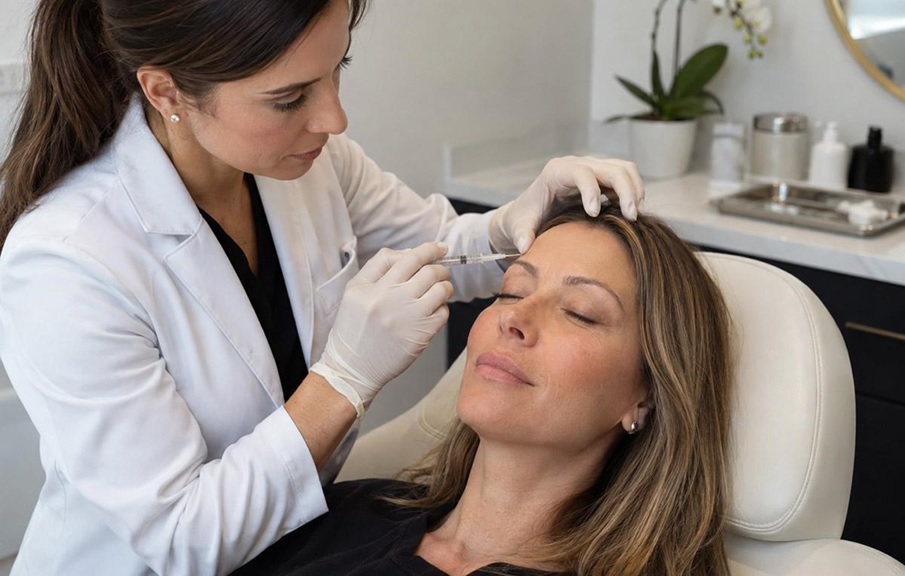
Botox, Dysport, and Xeomin are all botulinum toxin type A injectables that soften expression lines by quieting specific muscles. They differ in FDA-approved uses, in how the toxin is packaged, and in dosing units that do not convert between brands. Onset and duration are broadly similar, with small measured differences. The right choice depends on your anatomy, your treated areas, and your history, and it is decided at a consultation.
You have probably seen all three names on a menu of services and wondered whether the choice actually matters or whether it is mostly marketing. That question sits at the heart of Botox vs. Dysport vs. Xeomin, and it deserves a real answer. The three products share a mechanism, but they are not clones, and they are not dosed the same way.
At The One Plastic Surgery Center in Newport Beach, board-certified plastic surgeon Dr. Siamak Agha approaches neuromodulators the way he approaches surgery: by starting with your anatomy and your goals rather than with a product name. The practice’s Botox and neuromodulator treatments include Botox, Dysport, and Daxxify, and the choice of which one to use depends on muscle strength, treatment area, past response, and what you want your face to do when it moves.
This guide covers what the FDA has approved for each product, how their formulations differ, why units cannot be swapped, what research says about onset, duration, and spread, and why who holds the syringe matters as much as what is in it.
Botox vs. Dysport vs. Xeomin: One Mechanism, Three Products
Quick take: All three are purified botulinum toxin type A. Injected in tiny amounts into a targeted muscle, the toxin blocks the nerve signal telling that muscle to contract, so the skin above it creases less with expression.
The effect is temporary and local. Nerve endings recover, muscle activity returns, and lines reappear, which is why maintenance treatments exist.
The American Society of Plastic Surgeons describes the injection appointment as typically under 15 minutes but notes something that matters more than speed: there are 43 muscles in the face, and pinpointing the correct spots separates a natural result from a heavy one. That is a skill question, not a brand question.
- All three treat dynamic lines caused by muscle movement, not lines etched by sun damage or volume loss
- None add volume, which is what dermal filler treatments are for
- All three carry the same FDA boxed warning about toxin effects spreading beyond the injection site
Where the FDA Approvals Differ
Quick take: The three products have different approved uses. Botox Cosmetic carries the broadest set of cosmetic indications, while Dysport and Xeomin are approved cosmetically only for frown lines between the brows.
According to the FDA prescribing information for Botox and Botox Cosmetic, the cosmetic label covers moderate to severe glabellar (frown) lines, lateral canthal lines (crow’s feet), forehead lines, and platysma bands in the neck. Therapeutically, the same molecule is approved for chronic migraine prevention, cervical dystonia, spasticity, overactive bladder, blepharospasm, and severe underarm sweating.
Dysport’s FDA label lists cervical dystonia, spasticity in patients two years and older, and glabellar lines in adults under 65. Xeomin’s label covers glabellar lines, blepharospasm, cervical dystonia, upper limb spasticity, and chronic drooling.
Anything outside those lists is off-label use. Off-label injection is legal and common in experienced hands, but it should be a disclosed, discussed decision.
“Off-label does not mean improper, but it should always be an informed conversation, not an assumption.”
Formulation: Accessory Proteins and the “Naked” Toxin
Quick take: The active molecule is similar across products, but what surrounds it is not. Xeomin is manufactured without the accessory proteins that accompany the toxin in Botox and Dysport, which is where the “naked toxin” nickname comes from.
In nature, botulinum toxin travels as a complex: the 150 kDa neurotoxin plus hemagglutinin and non-hemagglutinin proteins that shield it. The Xeomin label states the product contains the active neurotoxin without those accessory proteins, stabilized with human albumin and sucrose. The Dysport label describes a formulation including hemagglutinin and non-hemagglutinin complexes, human serum albumin, and lactose, and notes that it may contain trace amounts of cow’s milk protein, which matters if you have a milk allergy.
A few practical implications:
- Accessory proteins detach quickly after injection, so they are unlikely to change how a single treatment performs
- Formulation differences matter most to total protein load over years of repeat treatment
- The milk protein note in Dysport’s label is a real screening question, not a technicality
A newer option, Daxxify, uses a peptide stabilizer instead of the conventional carrier. The FDA approved it in September 2022 for moderate to severe glabellar lines, with a label instruction not to repeat treatment more often than every three months.
Why the Units Do Not Convert Between Products
Quick take: A “unit” is defined by each manufacturer’s own potency assay. Units of one product cannot be compared to or converted into units of another, so brand-to-brand dose comparisons are meaningless.
Every one of these labels says so in plain language. The Botox label states that units of Botox Cosmetic cannot be compared to nor converted into units of any other botulinum toxin product. The Dysport label and the Xeomin label carry the same warning.
This is the most misunderstood point in the comparison. Patients hear that one product “takes more units” and read that as weaker or more diluted. It means neither. The measuring stick is simply different.
- Conversion ratios used in research are study conventions, not official equivalencies
- A higher unit count for one brand says nothing about strength or quality
- What matters clinically is your injector’s dosing experience with the product being used
Onset, Duration, and the Question of Spread
Quick take: Research shows small, measurable differences in how quickly these products take hold, with substantial overlap in how long results last. Individual variation is often larger than brand variation.
A randomized, double-blind study of 180 adults treated for glabellar frown lines compared incobotulinumtoxinA (Xeomin), onabotulinumtoxinA (Botox), and abobotulinumtoxinA (Dysport) over 180 days. Researchers reported a significantly earlier time to onset for incobotulinumtoxinA, with female participants seeing effects at roughly three days versus about five for the other two, and found that onset speed did not predict duration. Women had both faster onset and longer duration than men across all three products.
Spread, sometimes called diffusion or field of effect, is the other contested claim. A 2025 clinical trial mapping the actual treated area on the forehead found statistically significant differences in spread between products, while noting that dose, dilution volume, and injection technique are themselves known to significantly affect how far a product travels in tissue. The differences are real, but they sit alongside variables your injector controls directly.
“Dose, dilution, and technique shape spread as much as the brand printed on the vial.”
Antibody Resistance and Loss of Response
Quick take: A small number of patients stop responding to botulinum toxin over time. Antibodies explain only part of that, and in cosmetic dosing the risk appears low.
A published review of immunogenicity in botulinum toxin treatment describes secondary non-response as an initial benefit followed by a fading response in later cycles. Neutralizing antibodies were found in roughly 3.5 percent of patients still responding and about 53.5 percent of those who had stopped, meaning antibodies explain only about half of non-response cases.
The same review identifies the main risk factors, and they are dosing patterns rather than brands:
- Short intervals between sessions, especially touch-ups one to two weeks after treatment
- Higher doses per visit and higher cumulative doses over time
- Therapeutic indications requiring large doses, such as cervical dystonia
For aesthetic use, the picture is reassuring. Studies of glabellar line treatment in that review found no neutralizing antibodies across repeated cycles, and abobotulinumtoxinA phase III data showed roughly 0.19 percent of patients developing new antibodies. The practical takeaway is to space treatments sensibly.
Choosing Between Botox, Dysport, and Xeomin Safely
Quick take: Product selection is individualized, and it matters less than two questions underneath it: Is your injector properly trained, and did the product come from a legitimate source?
The FDA and CDC both moved on the issue in 2024. The CDC documented 17 cases across nine states with 13 hospitalizations after counterfeit or mishandled botulinum toxin injections, including blurred vision, drooping eyelids, swallowing difficulty, and muscle weakness. Some products had been bought through online marketplaces rather than authorized suppliers, and some were injected by unlicensed providers. CDC advice is blunt: verify the provider is licensed and trained, confirm the product is FDA-approved, and if in doubt, skip the injection.
The FDA separately issued warning letters to websites illegally marketing unapproved botulinum toxin products, noting that products from unauthorized sources may be misbranded, adulterated, counterfeit, contaminated, or improperly stored.
ASPS reinforces the point from the credentialing side, urging patients to confirm board certification by the American Board of Plastic Surgery and to be wary of official-sounding boards that are not recognized. ASPS also notes that toxin effects can rarely spread beyond the treatment area and cause botulism-like symptoms needing urgent care.
A Newport Beach consultation covers how strong your muscles are, which areas you want treated, how you responded before, any allergies, and whether an injectable is the right tool at all. Etched static lines may respond better to resurfacing, volume loss is a filler question best answered by options such as Juvederm, and significant laxity leads toward a facelift.
Key Takeaways
- Botox, Dysport, and Xeomin all use botulinum toxin type A, but their FDA-approved uses are not identical.
- Xeomin is formulated without accessory proteins, and Dysport may contain trace cow’s milk protein.
- Units are product-specific and cannot be converted between brands, so unit counts do not measure strength.
- Research shows modest differences in onset and spread, with individual variation often outweighing brand differences.
- Provider training and verified, FDA-approved product matter more to your safety than the brand you choose.
Results and candidacy vary by patient. The information here is educational and is not a substitute for medical advice. A consultation with a qualified physician is required to determine whether any injectable treatment is appropriate for you.
Making the Right Choice for Your Face
The answer to Botox vs. Dysport vs. Xeomin is that all three are well-studied, FDA-approved products with more in common than not. Differences in formulation, approved indications, onset, and spread are real, and they occasionally point toward one option. More often, the outcome is decided by anatomy, dosing judgment, and injection placement rather than the label on the vial.
Ready to find out which neuromodulator suits your face and your goals? Schedule a consultation with board-certified plastic surgeon Dr. Siamak Agha at The One Plastic Surgery Center in Newport Beach to review your treatment areas and your history with injectables.
Frequently Asked Questions
Is Dysport weaker than Botox because it takes more units?
No. Each manufacturer defines its potency unit using its own assay, and the FDA labels for both products state that units cannot be converted between brands. A higher unit number reflects a different measuring system, not a weaker product.
Can I switch from one botulinum toxin brand to another?
Many patients do switch, and there is no requirement to stay with one product. Your injector will re-dose from scratch using the new product’s own dosing conventions rather than converting your previous dose, and the onset may feel slightly different the first time.
What is the difference between Xeomin and the other two products?
Xeomin is made without the accessory proteins that surround the neurotoxin in Botox and Dysport, which is why it is sometimes called a “naked” toxin. Its FDA-approved cosmetic use is limited to frown lines between the brows, and its therapeutic approvals differ from the other two.
Can botulinum toxin stop working over time?
A small number of patients lose response after repeated treatment. Published research links this phenomenon partly to neutralizing antibodies and identifies short intervals between sessions and higher cumulative doses as the main risk factors, which is why spacing treatments appropriately matters.
How do I know the product being injected is legitimate?
Ask where the product is sourced, confirm it is FDA-approved, and confirm your provider is licensed and trained. The CDC and FDA have both warned about counterfeit and improperly sourced botulinum toxin sold outside authorized supply channels, and CDC guidance is to skip the injection if you are uncertain.