

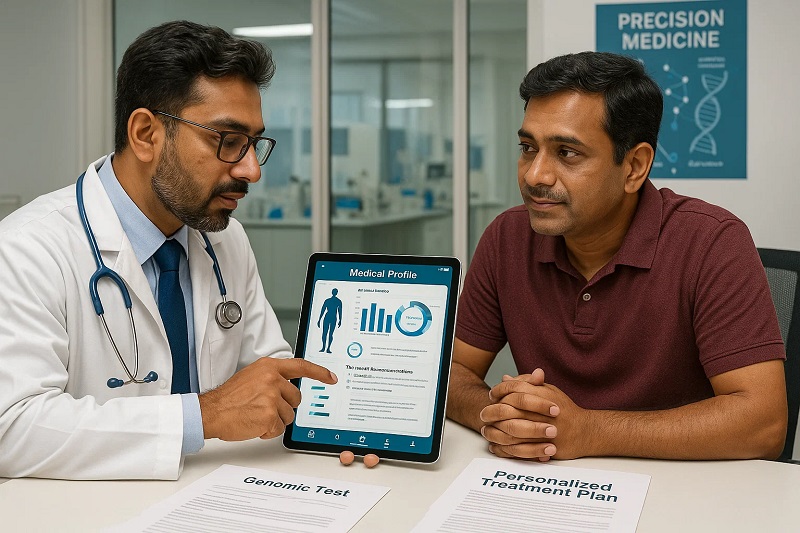
For over a century, modern clinical practice has relied on the logic of the statistical average. Clinical trials test interventions on broad population cohorts, identify what works for the mathematical median, and establish standardized treatment guidelines. Yet anyone who has watched two patients with the identical diagnosis respond in completely opposite ways to the same medication understands the limitation of that model. One patient experiences immediate symptom relief, while the other endures debilitating adverse reactions with no measurable benefit. The human body does not conform to standardized baselines, and treating it as though it does has long been one of medicine’s greatest compromises.
Personalized healthcare—often termed precision medicine—represents a departure from this population-level guesswork. Rather than categorizing illness solely by outward symptoms or anatomical location, this approach examines each individual’s unique genetic code, molecular biology, environment, and daily lifestyle. By replacing trial-and-error interventions with targeted, biologically tailored therapies, personalized medicine is transforming clinical practice from a reactive damage-control system into a proactive, individualized discipline.
Dismantling the One-Size-Fits-All Model
The traditional medical framework relies heavily on reactive interventions. A patient develops persistent fatigue, localized pain, or abnormal blood markers; they visit a clinic, receive a broad diagnostic label such as hypertension, clinical depression, or rheumatoid arthritis, and start a standard first-line therapy. If that drug fails or produces intolerable side effects, the clinician switches them to a second-line option. This cycling through pharmaceuticals can drag on for months or years, taxing the patient physically, emotionally, and financially.
The shortcoming of this approach is not clinician competence, but biological heterogeneity. Two tumors that look indistinguishable under a traditional microscope may be driven by entirely different genetic mutations. Similarly, two individuals diagnosed with major depressive disorder may have distinct neurochemical and inflammatory profiles driving their symptoms.
Personalized healthcare acknowledges that disease is as unique as the person carrying it. By analyzing molecular fingerprints, clinicians can pinpoint the exact biological mechanisms malfunctioning in a specific patient and choose an intervention specifically engineered to address that pathway on day one.
Core Pillars Driving the Precision Revolution
The transition toward bespoke medical care is not driven by a single discovery, but by the convergence of high-throughput sequencing, advanced data analytics, and real-time biological monitoring.
Pharmacogenomics and Tailored Prescribing
One of the most immediate, practical applications of precision medicine is pharmacogenomics—the study of how an individual’s genetic makeup affects their response to drugs. The liver metabolizes pharmaceuticals primarily through a family of enzymes known as the cytochrome P450 system. Genetic variations dictate whether a person metabolizes a specific drug rapidly, normally, or poorly.
A rapid metabolizer might clear a standard dose of pain medication or an antidepressant before it has any therapeutic effect, leading a doctor to assume the drug is ineffective. Conversely, a poor metabolizer will accumulate toxic concentrations of the same compound in their bloodstream, causing severe adverse reactions. By screening a patient’s genetic profile prior to writing a prescription, clinicians can select the right drug and calculate the precise therapeutic dosage immediately, eliminating weeks of painful trial and error.
Molecular Profiling in Oncology
Nowhere has the impact of precision medicine been clearer than in cancer treatment. Historically, oncology classified malignancies strictly by their tissue of origin: lung cancer, breast cancer, or colon cancer. Treatment regimens were largely blunt instruments—surgical resection, radiation, and systemic chemotherapy designed to kill rapidly dividing cells indiscriminately.
Today, advanced genomic profiling allows oncologists to sequence the DNA and RNA of a tumor to identify its specific driver mutations. A patient with non-small cell lung cancer displaying an EGFR mutation or an ALK rearrangement receives a targeted tyrosine kinase inhibitor rather than broad-spectrum chemotherapy. In many cases, these targeted therapies shut down cancer cell signaling pathways while sparing healthy tissue, dramatically improving survival rates and preserving the patient’s functional quality of life during treatment.
Continuous Biometric Narratives
Precision medicine extends far beyond laboratory genetic panels. Wearable biosensors, continuous glucose monitors, and mobile diagnostic tools are fundamentally changing how physiological data is collected.
Traditional medicine relies on episodic snapshots: a blood pressure reading taken during an anxious doctor visit once a year, or a fasting lipid panel drawn after twelve hours of starvation. Wearable technology replaces those disconnected snapshots with a continuous physiological narrative. Tracking heart rate variability, sleep architecture, glycemic fluctuations, and arterial stiffness in real-world conditions gives healthcare providers a clear picture of how a patient’s body actually behaves during daily life, uncovering subclinical irregularities long before they evolve into acute clinical crises.
Shifting from Reaction to Interception
The greatest long-term benefit of personalized healthcare lies in shifting the clinical timeline. Current healthcare spending is overwhelmingly devoted to managing advanced chronic diseases—heart failure, end-stage renal disease, diabetic neuropathy, and late-stage neurodegeneration. These conditions develop quietly over decades before producing noticeable symptoms.
Through the integration of polygenic risk scoring and biomarker analysis, clinicians can identify an individual’s susceptibility to complex conditions well before cellular damage occurs. A patient found to carry an elevated genetic predisposition for cardiovascular disease can be placed on targeted lifestyle protocols, early lipid-lowering therapies, and focused vascular imaging in their thirties rather than waiting for an emergency room visit in their fifties. This transition from late-stage reaction to early interceptive care has the potential to spare patients profound suffering while simultaneously stabilizing strained healthcare economies.
Overcoming Structural and Ethical Hurdles
While the promise of personalized medicine is undeniable, realizing its full potential requires navigating complex ethical and systemic challenges.
The primary concern is accessibility and health equity. Advanced genomic sequencing, bespoke cellular therapies, and targeted biologics currently carry immense financial costs. If personalized healthcare remains restricted to well-funded research hospitals or affluent patients, it risks widening existing health disparities. Scaling these technologies so they can be integrated into community clinics and rural health systems is an urgent priority.
Data privacy presents another major hurdle. Precision medicine depends on collecting, storing, and analyzing vast repositories of deeply personal biological data. Safeguarding patient genomic profiles from commercial exploitation, data breaches, or discriminatory use by insurers demands robust legal safeguards and uncompromised cybersecurity standards.
Furthermore, medical education must evolve. The sheer volume of biological data generated by modern testing can easily overwhelm busy primary care physicians. Bridging the gap between computational bioinformatics and everyday clinical decision-making requires intuitive diagnostic interfaces that translate complex genomic data into actionable, evidence-based recommendations at the bedside.
Personalized healthcare is not a distant, speculative future; it is already reshaping clinical standards across specialties. As our understanding of human biology deepens and sequencing technologies become more accessible, the era of relying on population averages will come to a close. Medicine is finally learning to treat the individual in front of the stethoscope, ushering in an era of care that is more precise, humane, and enduringly effective.